Clinical continuity
Map the consequence and maximum interruption for each protected function.
Hospital solar + BESS engineering • Philippines
For an ordinary building, a blackout can mean lost productivity. For a hospital, it can become an operational and patient-safety risk. S3 starts with the protected functions, electrical architecture and failure states—then qualifies the equipment.
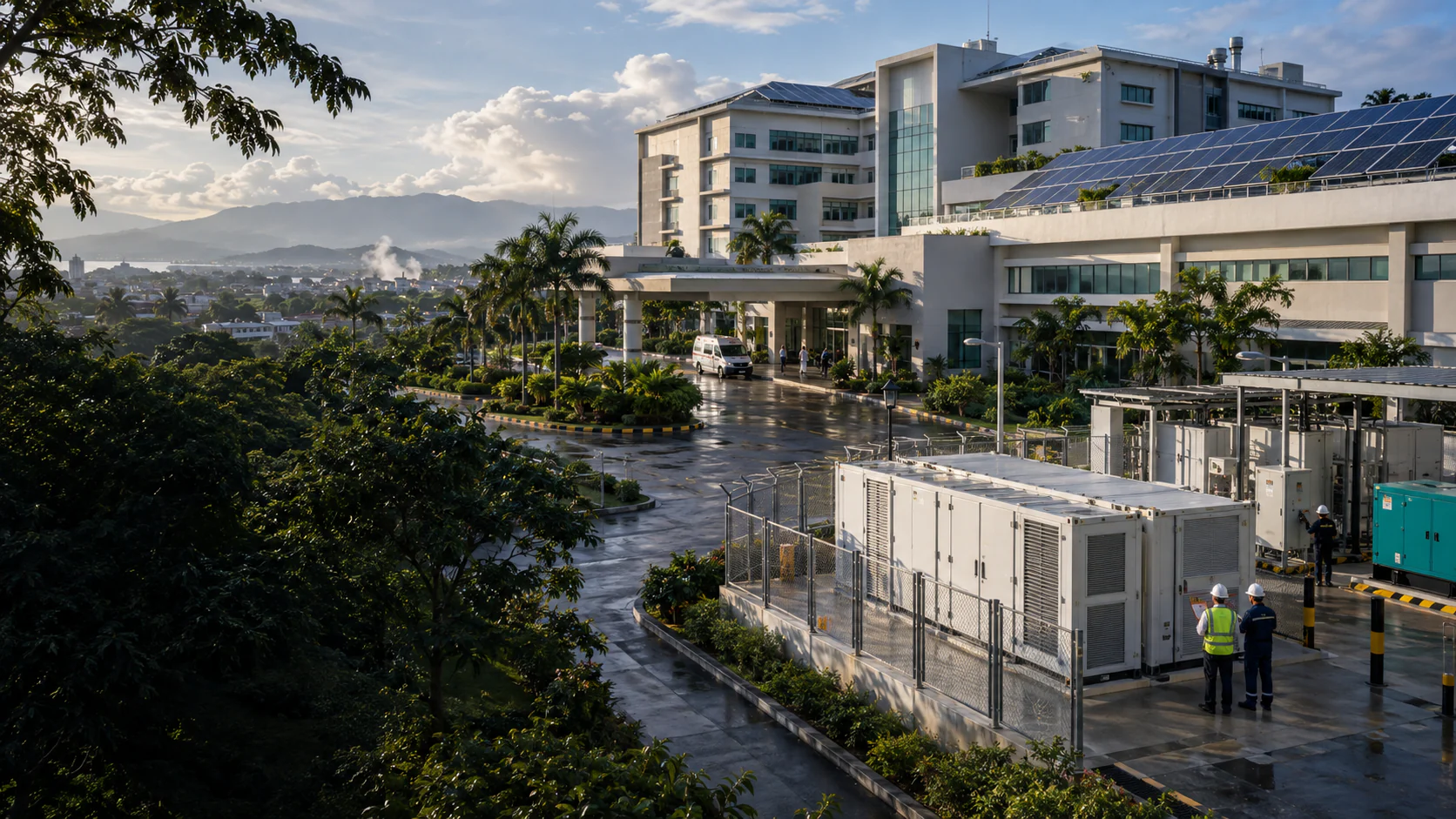
Do not begin with “Which battery brand should we buy?”
Why hospital loads are different
Operating rooms, intensive care, diagnostics, laboratories, refrigeration, communications, emergency lighting, pumps, IT and operationally critical HVAC can all matter. They do not automatically share the same statutory classification or interruption limit.
Map the consequence and maximum interruption for each protected function.
Measure peak power, motor starts, harmonic or reactive demand and restart sequence.
Include controls, networks, cooling, pumps and auxiliaries needed by the protected service.
Verify the safe state after source, controller, communications or transfer failure.
PEC Article 5.17
Article 5.17 addresses health-care facilities and the continuity of designated functions through an essential electrical system. The practical boundary includes normal and alternate sources, distribution, transfer, ancillary equipment and the loads being served.
A BESS does not automatically satisfy Article 5.17. Historical wording recognizes battery systems only where permitted as alternate sources. The licensed current PEC edition, facility classification, branch requirements, source permissions, transfer arrangements and AHJ interpretation must be verified for the actual hospital by competent Philippine professionals.
Philippine healthcare and energy context
DOH’s 2025 Green and Safe Health Facilities activity included energy efficiency and environmentally resilient health-facility performance areas. That direction supports better energy planning; it does not replace electrical, hospital or fire-safety compliance.
Connect energy decisions to continuity of care, operating conditions and the facility’s current licensing and design requirements.
Screen the actual ownership, connection, operating mode and market role under the 2026 ESS framework and applicable zero-export route.
Resolve technology, location, access, separation, detection, protection, emergency isolation and response with the project’s BFP/AHJ route.
Solar alone is not backup power
Anti-islanding protects the distribution system. Blackout operation requires intentional isolation, a valid local voltage and frequency reference, coordinated protection, transfer logic and a defined load bus. Some PCS products can be grid-forming; many cannot, and every claim is configuration-specific.
Cost control, solar use and maintained resilience reserve.
*Only within an approved island-capable architecture.
The role of BESS
During normal grid conditions the same asset may manage solar and demand. During an outage it may bridge transfer, support a protected bus or coordinate with generation. Those duties compete for capacity and must preserve the approved emergency reserve.
Steady load, short overload, motor starting, reactive power and step response.
Usable AC energy after SOC window, losses, auxiliaries, temperature and degradation.
Grid present, transition, island, low SOC, generator unavailable and recovery.
BESS is not just a big UPS
UPS and BESS can share technologies while performing different duties. The study must confirm PCS behavior, grid-forming capability, transfer, protection, energy management, autonomy, load priority, fault response and maintenance bypass—not infer them from the product label.
Critical-load segmentation
Functions whose interruption can create immediate clinical or safety consequence. Determine whether no-break support is required.
Loads that can tolerate a defined short interruption but need controlled restoration before an extended outage develops.
Loads that an approved outage plan can hold off so finite power and energy remain available for higher priorities.
These are planning classes. The project PEE and hospital team must map the applicable current PEC classifications and clinical requirements.
Can the PCS carry the peak, steps, motors and reactive duty?
How long can usable AC energy support the scenario and reserve?
Scenario markers are planning cases—not universal legal autonomy requirements.
How much BESS?
BESS energy requirement is not monthly consumption divided by thirty. A defendable model uses the critical-load time series, peak kW, usable kWh, PCS overload, allowed SOC, degradation, redundancy, outage duration, generator availability, conservative solar availability and recharge strategy.
Cyber-physical resilience
Cloud tools can add value, but basic safe operation should have an approved local state. S3 reviews internet loss, EMS communications loss, stale BMS data, unavailable remote access, controller failure, update/rollback, logging and authorized manual control.
Where personal data is processed, Philippine privacy duties must also be mapped. Ordinary power telemetry should not be mislabeled as personal information without examining the actual data flow.
Normal operation + resilience
Solar self-consumption, demand reduction where the tariff supports it, energy shifting, generator optimization and outage support can coexist. The model must keep the value streams separate, reserve emergency energy and include degradation, auxiliaries, service and residual risk.
S3 hospital energy resilience approach
The scope is matched to available data and the hospital’s decision. S3 does not present a preliminary review as regulated final design or permit approval.
Bills, interval data, disturbance records and one-line verification.
Clinical consequence, interruption tolerance and operating priority.
Generator, UPS, distribution, transfer, protection and maintenance condition.
Frequency, duration, second failure, fuel and recovery states.
Electrical boundaries, source sequence and island concept.
Peak kW, usable AC kWh, reserve, ageing and redundancy.
Fault states, interlocks, local control and graceful degradation.
Separate savings, lifecycle cost and residual-risk ledger.
Comparable requirements, evidence requests and FAT/SAT criteria.
Hospital solar + BESS engineering series
Each article resolves one part of the same decision: code boundary, sizing, architecture, hybrid operation, cyber resilience and whole-life value.
An engineering guide to hospital solar, BESS, essential electrical systems and brownout resilience under Philippine Electrical Code Article 5.17.
Read technical guide Hospital BESS sizing • 9 Sep 2026Size hospital battery storage from critical-load power, usable kWh, outage scenarios, generator availability and recovery—not monthly consumption alone.
Read technical guide Hospital electrical architecture • 9 Sep 2026Understand how hospital BESS, UPS, transfer systems, essential buses, protection and microgrid controls differ in Philippine healthcare power design.
Read technical guide Hybrid hospital power • 9 Sep 2026How PV, battery storage and generators can coordinate around protected hospital loads without simplistic battery-replaces-diesel claims.
Read technical guide Cyber-physical resilience • 9 Sep 2026Engineering local control, secure remote access and graceful degradation for hospital BESS, EMS, PCS and BMS systems in the Philippines.
Read technical guide Hospital energy economics • 9 Sep 2026Build a defensible hospital solar and BESS business case from measured savings, diesel displacement, outage consequences, lifecycle cost and resilience.
Read technical guidePrimary sources and evidence boundary
The complete current PEC is copyrighted and not reproduced here. References to Article 5.17 are conservative paraphrases. Final classification, design, sign-and-seal responsibilities and approval must be confirmed using the licensed current edition and competent Philippine professionals/AHJ.
Free initial hospital energy assessment
Start with the facility type, approximate electricity use, existing generator/UPS/solar, known outage experience and the decision you need to make. The initial desktop review is free and identifies evidence gaps and the smallest useful next step. If deeper work is justified, you receive a separate proposal to approve before it begins.